
Five Women, Five Years
On The Herstorian's birthday, let's remember five women that you were probably never taught about.

Hello, dear reader,
Today is The Herstorian’s fifth birthday and I am wishing her many happy solar returns! 🎂💕
Last week, I wrote about the Suffragette Handkerchief, an amazing item that was made by Suffragettes while in prison for window-smashing campaign in 1912. That post was inspired by my own desire to learn more about the women’s suffrage campaign. I used to think I knew quite a lot about this period in history but I have been humbled, dear reader. I know virtually nothing, so let me take this opportunity to share some knowledge that maybe you don’t know, either.
So, in honour of The Herstorian’s fifth birthday and me being humbled by herstory, here are five Suffragettes that you *need* to know about …
1. Leonora Cohen (1873-1978), AKA, ‘The Tower Suffragette’
Born into a working-class family in Leeds, Cohen would later say that her mum’s feelings of powerlessness inspired her activism:
“My mother would say, ‘Leonora, if only we women had a say in things,’ but we hadn’t. A drunken lout of a man had a vote simply because he was a male. I vowed I’d try to change things.”
And that’s what she did. She joined the Women’s Social and Political Union in 1909 where she took part in many of their direct action campaigns. For example, in 1911, she spent a week in Holloway Prison after throwing a rock at the window of a government building. Later, she was arrested again for punching a policeman. But her piece-de-resistance happened in 1913 when she used an iron bar to smash a glass case containing insignia of the Order of Merit in the Tower of London’s Jewel House. It was for this act that she became known as the Tower Suffragette. She was also a personal bodyguard to the WSPU’s founder, Emmeline Pankhurst.
As well as her suffrage activities, Cohen was an early female trade unionist, involved in the National Union of General and Municipal Workers. In 1923, she became the first woman president of the Yorkshire Federation of Trades Councils. The next year, she became one of the Britain’s first female magistrates. She was also a lifelong vegetarian and made a connection between this choice her activism, arguing that if women didn’t have to prepare meat, they could spend less time in the kitchen and more time pursuing other interests. She died in 1970.
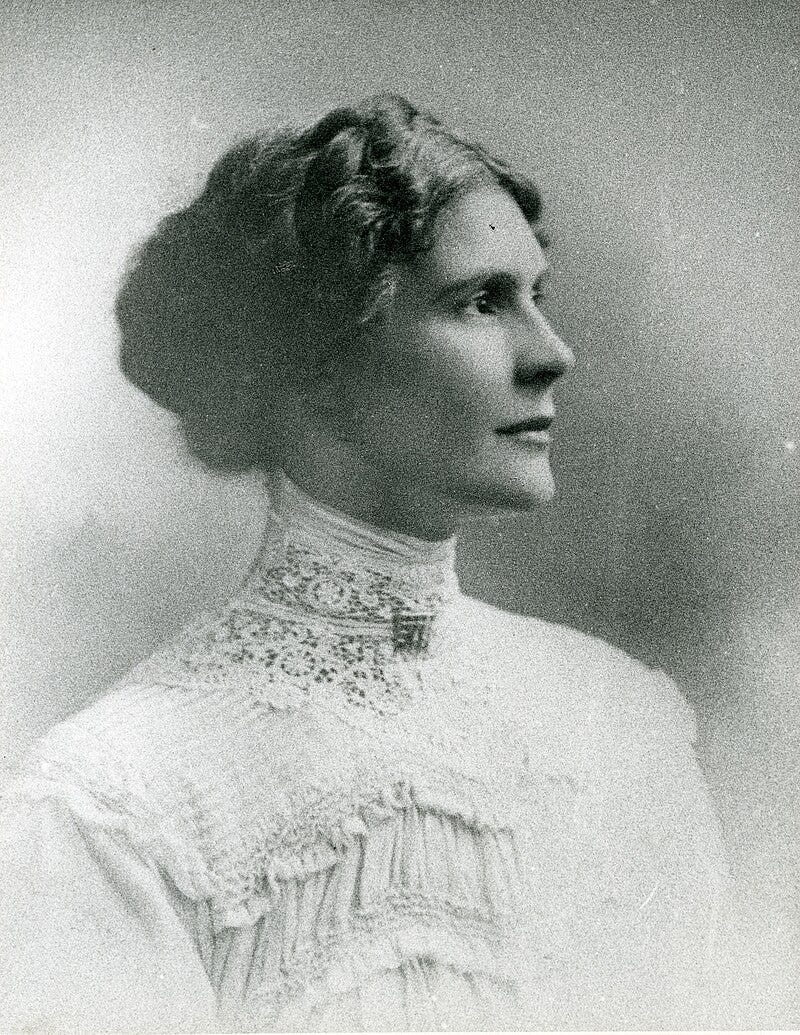
2. Laura Annie Wilson (1877-1942) and the BEST quote I have EVER read.
I encourage you to go away and do some Googling on this woman because I just want to share with you one moment in her life story …
In 1907, she took part in a weavers’ strike in the beautiful little town of Hebden Bridge in Yorkshire, very close to where she worked. That strike was infamous because its organisers had invited Emmeline Pankhurst to speak. The result was described as a ‘riot’ and Wilson was arrested for “breach of the peace.” She spent 14 days in prison and, on her release, she said:
“I went to gaol a rebel, but I have come out a regular terror.”
MIC DROP
Reading that quote made me bite my hand out of pure joy. I have NEVER read anything that hyped me up like that 😂 (And you better believe she lived out the rest of her days as a regular terror!)
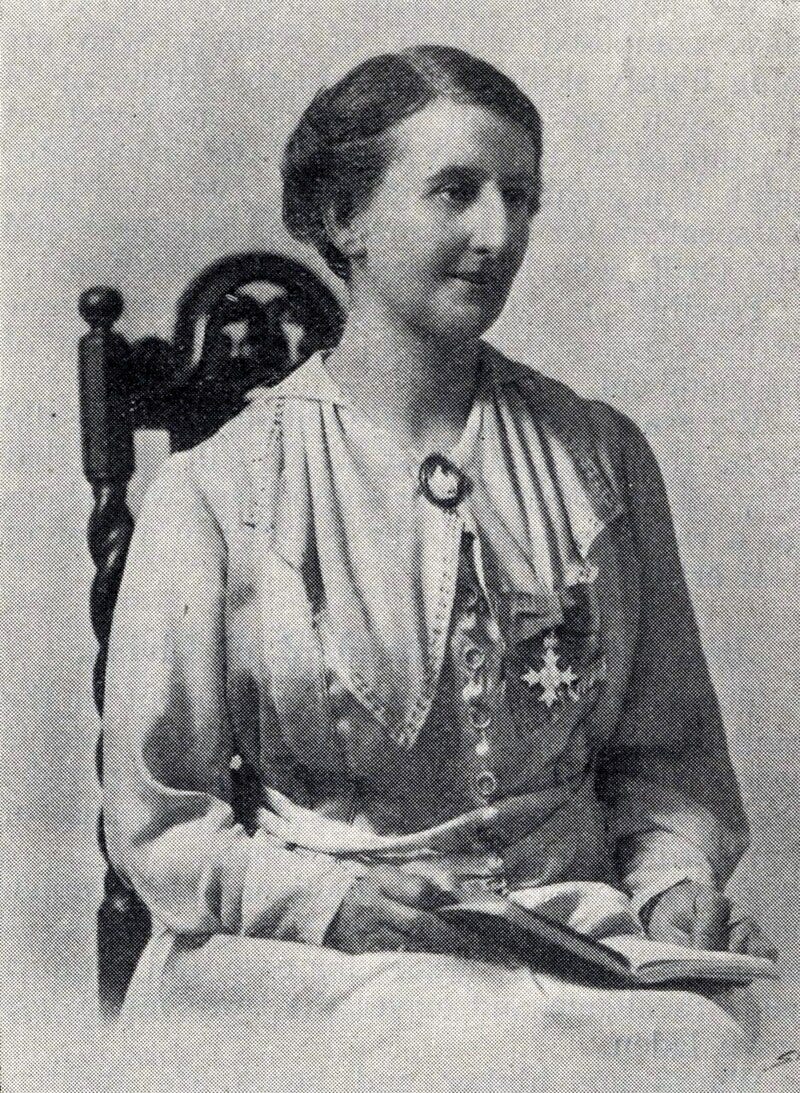
3. Lavena Saltonstall (1881-1957) and Working-Class Womanhood
Saltonstall was also present at the 1907 strike in Hebden Bridge. In fact, she led the strike and personally invited Emmeline Pankhurst to speak.
Like Laura Annie Wilson, I urge you to go away and read a bit about her life and work so I can just focus on one beautiful moment. And this moment is a quote she left behind. Saltonstall wrote many articles for the Women’s Education Association (WEA) and this comes from one of those:
“As I am a tailoress many people think it is my bounden duty to make trousers and vests, and knit and crochet and sew, and thank God for my station in life. I am supposed to make myself generally uselessby ignoring things that matter – literature, music, art, history, economics, the lives of people round me and the evils of the day. They think I ought to concern myself over clean doorsteps and side-board covers….
In my native place. the women, as a general rule, wash every Monday, iron on Tuesdays, court on Wednesdays, bake on Thursdays, clean on Fridays, go to market or go courting again on Saturdays, and to church on Sundays. There are exceptions, of course, hundreds of exceptions, but the exceptions are considered unwomanly and eccentric people…The majority of girls are brought up by well-wishing parents to earn their living, to become thoroughly domesticated, to behave respectably, go to Sunday school and read religious books, all with a view to one day getting married. The “getting married idea” is the most important one in most girls’ lives. No account is taken of the fact that just as faces are different, so are temperaments… Should any girl show a tendency to politics, or to ideas of her own, she is looked upon by the majority of women as a person who neglects doorsteps and home matters, and is therefore not fit to associate with their respectable daughters and sisters.”
What a stunning description of working-class womanhood she left us with.
Sadly, I have no image of Lavena to share with you.
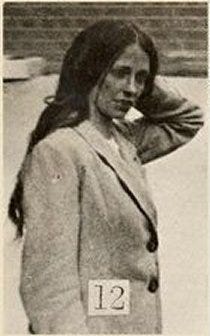
4. Lilian Lenton (1891-1972), AKA the Tiny, Wily, Elusive Pimpernel
“Whenever I was out of prison my object was to burn two buildings a week… The object was to create an absolutely impossible condition of affairs in the country, to prove it was impossible to govern without the consent of the governed.”
Just let that quote sit with you for a minute - impossible to govern without the consent of the governed. Powerful.
After leaving school in Leicestershire, Lenton trained as a dancer school and likely intended on pursuing a rather respectable career. But all that changed when she heard Emmeline Pankhurst speak about women’s suffrage. I’m not sure how old she was (I think maybe 19 or 20) but the impact of hearing Pankhurst was huge: the day she turned 21 and could claim her independence, she joined the Women’s Social and Political Union.
Lenton took part in many, many direct action campaigns before the suspension of militant activism in 1914. She was arrested and force-fed so many times that she earned the WSPU’s Hunger Medal for her bravery. She absconded from so many crimes scenes that she was known as the “tiny, wily, elusive Pimpernel.”
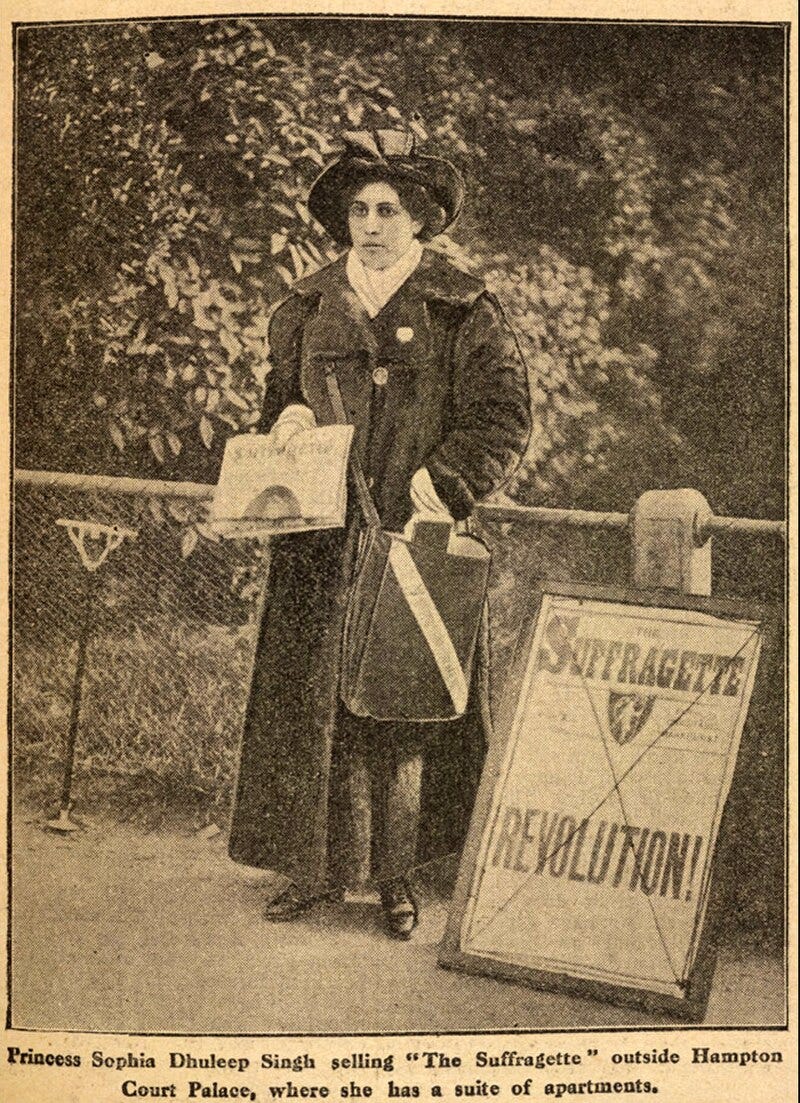
5. Sophia Duleep Singh (1876-1948): Through Thick and Thin, We Never Give In
Singh is the most high-profile Suffragette on my list this week because she was royalty. You may well know her name already, but do you know that as well as being a prominent Suffragette, she was a leading member of the Women’s Tax Resistance League?
She coined so many cool phrases, like “Through thick and thin, we never give in,” (MIC DROPPPP) but this is my favourite quote:
“When the women of England are enfranchised and the State acknowledges me as a citizen, I shall, of course, pay my share willingly towards its upkeep, if I am not a fit person for the purposes of representation, why should I be a fit person for taxation?”
And another favourite:
“Taxation without representation is a tyranny… I am unable to pay money to the state, as I am not allowed to exercise any control over its expenditure.”
The British official, Sir William Connington, once asked: “Can anything be done to stop her?”
HAHAHAHA, NO.
I think what I love most about her is that she just rolled up her sleeves and got on with it all. Her royal background was utterly irrelevant.
So, that’s my five years and five women.
Did you learn anything new today? Let me know!
Until next time,
Kaye x